

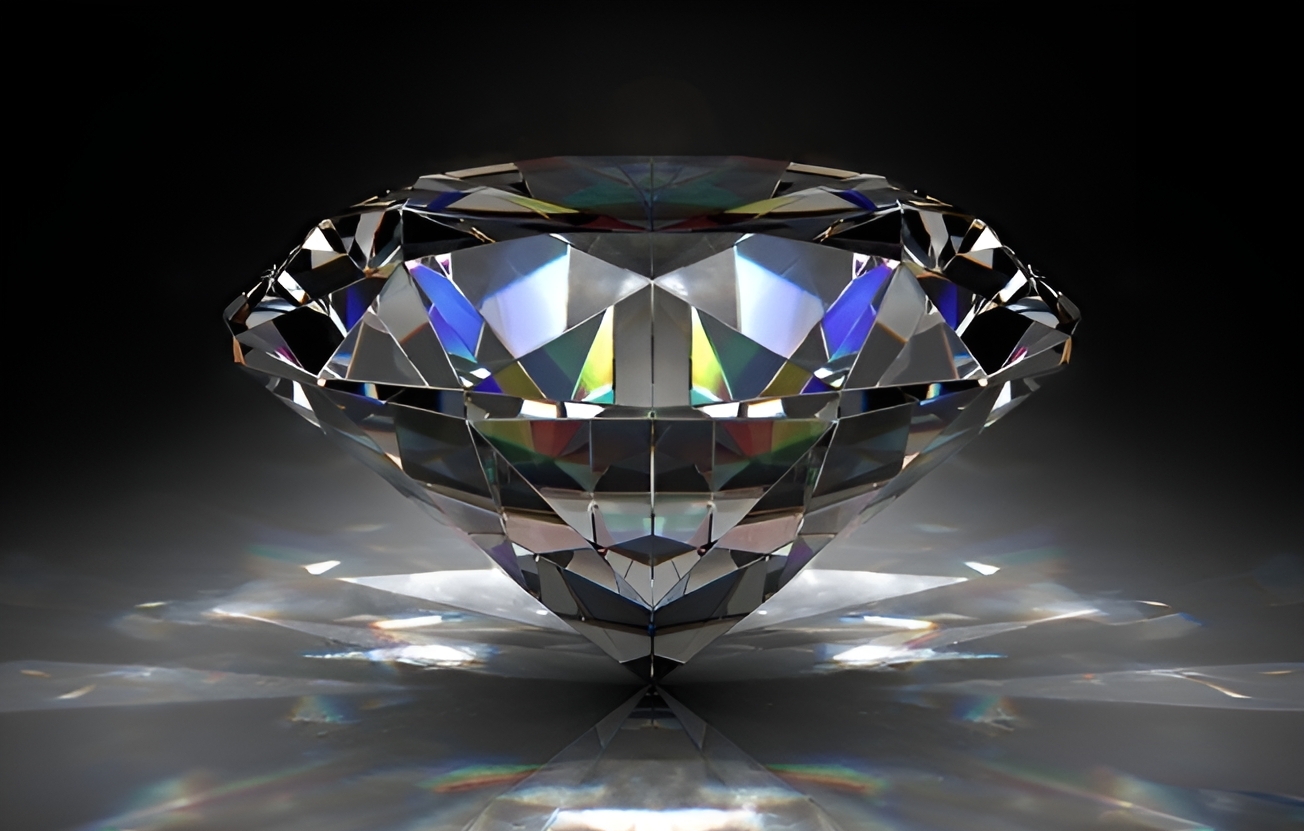
Diamond: Shapes and Facets of the Cut
Natural and lab-grown diamonds are not used in jewelry in the same form in which they are mined or produced. They acquire their value as gemstones only once they are skillfully cut and polished to become true diamonds.
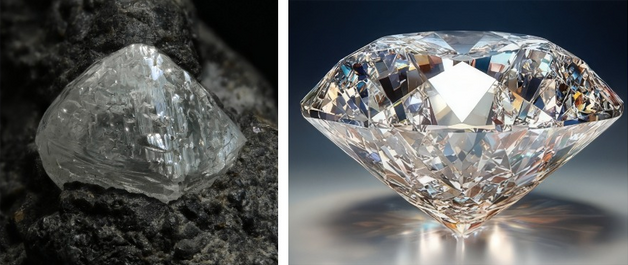
A diamond is a gemstone that has been cut into a precise shape to maximize its ability to reflect and refract light. The word “diamond” comes from the French brillant, meaning “sparkling”. It is cutting that transformed the diamond into the most coveted gemstone in the world of fine jewelry.
Although diamonds have been known as valuable gems since ancient times, they were not cut, as people believed that cutting would diminish their mystical powers. Only in the 4th century AD did Indian craftsmen begin shaping natural diamonds along their existing facets.
The concept of brilliant cutting emerged in Europe at the end of the 17th century, alongside the growing understanding of diamond optics and advancements in cutting techniques. Since then, the round brilliant cut — with its 58 facets — has become the most popular. However, the 58th facet, known as the culet, is optional, which is why modern brilliant-cut diamonds often have 57 facets.
Faceting Elements of a Round Brilliant Diamond
Diamond is the hardest known mineral on the Mohs scale due to its cubic crystal lattice composed of carbon atoms. The word “diamond” derives from a term meaning “the hardest”. This unique property makes it impossible to create two absolutely identical diamonds, although they all follow the same basic structural pattern [1].
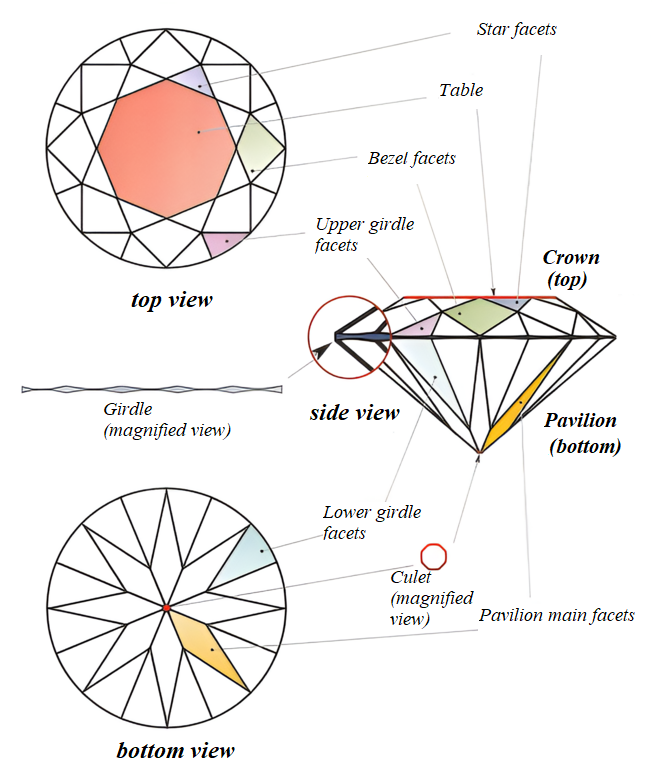
Girdle — the narrow band forming the perimeter of the diamond at its widest point, separating the crown (upper part) from the pavilion (lower part).
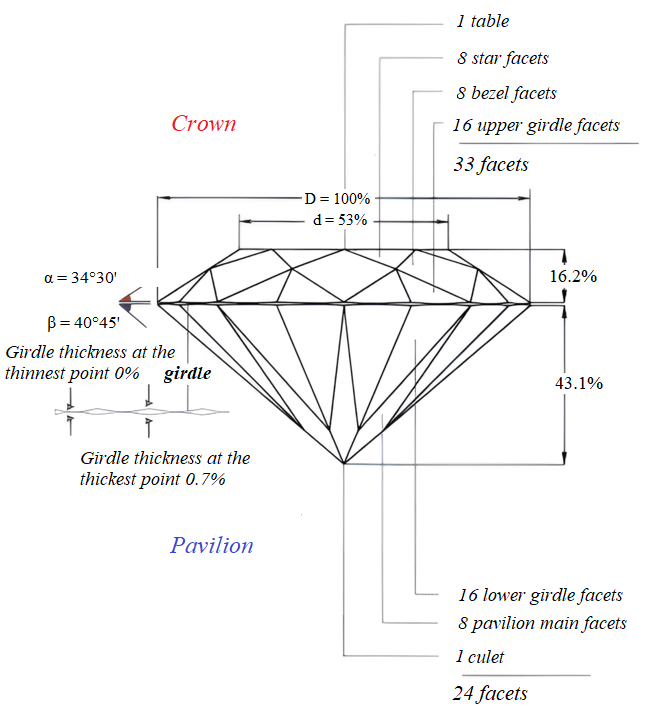
Pavilion — the lower portion of the diamond, located below the girdle and consisting of 24 facets.
Pavilion main facets — eight principal kite-shaped facets on the pavilion that converge toward the culet.
Crown — the upper portion of the diamond above the girdle, consisting of 33 facets.
Table — the large, flat, octagonal facet at the top of the crown; the largest facet on the diamond.
Star facets — eight triangular facets that extend outward from the table toward the bezel facets.
Bezel facets — eight main crown facets located between the star facets and the girdle.
The ideal proportions of the brilliant cut were established by Marcel Tolkowsky in 1919 in his landmark work Diamond Design, where he described the behavior of light within a faceted diamond [2]. According to his calculations, maximum brilliance and fire are achieved when the table diameter is 53 % of the girdle diameter, the crown angle is 34°30′, and the pavilion angle is 40°45′. These proportions have since been confirmed in practice through the assessment of high-quality diamonds.
Fancy Diamond Cuts
Although Tolkowsky’s proportions are still considered the benchmark for ideal diamond cutting, master cutters have always sought to preserve as much of the original rough as possible and to reveal the stone’s natural beauty in new and innovative ways. Over time, this led to the emergence of alternative shapes, now known in the jewelry industry as fancy cuts [3].
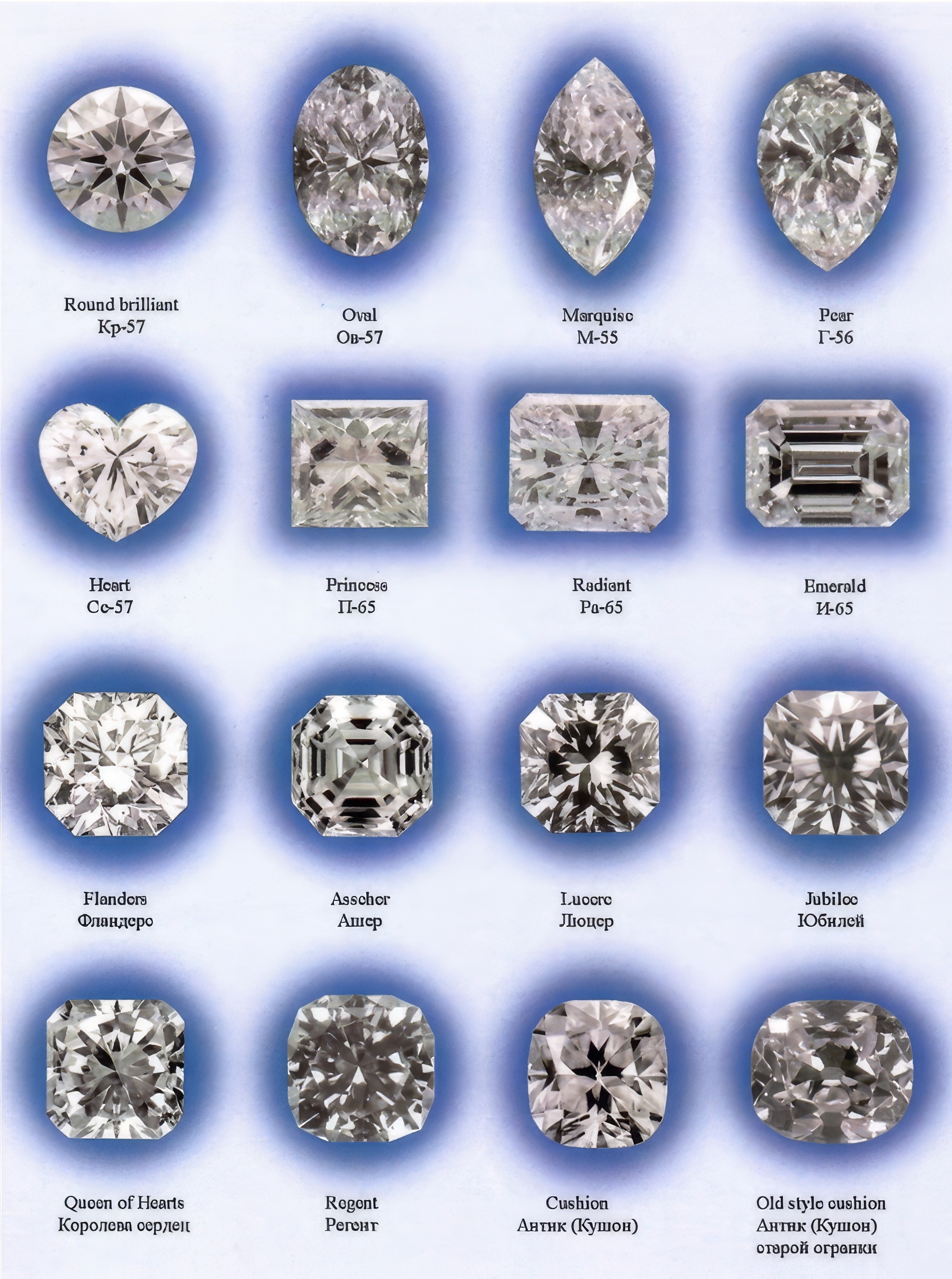
Fancy cuts are generally classified into three main categories:
- Brilliant-style cuts, which resemble the round brilliant in appearance:
- Oval
- Marquise
- Pear
- Heart
- Cushion
- Step cuts, defined by their parallel, tiered facets:
- Baguette
- Emerald
- Asscher
- Mixed cuts, which combine the sparkle of brilliant facets with the geometry of step cuts:
- Princess
- Radiant
- Octagon
Market Distribution by Cut (1-Carat Stones, Mumbai Diamond Exchange):
- Round Brilliant — 56.6 %
- Cushion — 8.7 %
- Oval — 7.3 %
- Pear — 7.0 %
- Emerald — 5.7 %
- Princess — 5.3 %
- Radiant — 4.5 %
- Heart — 2.5 %
- Marquise — 2.4 %
The dominance of the round brilliant cut is due to its superior light performance, ease of setting in jewelry, and durability — with no sharp corners or edges that are prone to chipping.
Thanks to modern cutting technologies, diamonds today come in a wide array of shapes and scintillation styles. Expert jewelers skillfully design settings that enhance each stone’s individuality. As a result, every cut is more than a visual choice — it becomes an expression of personal taste, character, and style. A diamond of any shape can be a collector’s treasure or a timeless gift of deep meaning.
References
No items defined
No items defined
